Book

How to read an audiogram


During your hearing test, a hearing care professional will perform a series of tests and record your results on a graph known as an audiogram. They'll guide you through interpreting the audiogram, helping you better understand your hearing.

What is an audiogram?

An audiogram is a chart that shows how well you hear different sounds. It’s made using the results from your hearing test. The audiogram helps demonstrate which sounds you hear clearly and where you might have trouble—especially when communicating with family or friends. It also shows if you have hearing loss, how much, and what kind.


Hearing loss can happen at any age. But starting around age 50, your hearing might begin to change. That’s why it’s a good idea to get your hearing checked regularly—especially if you’re over 50.

Dr. Husmita Ratanjee-Vanmali, Head of Audiology, Audika Global
9.4/10 Based on 144,642 reviews
Woman smiling and taking hearing test with headphones

Would you like to get your hearing tested?

Book a free hearing test - No obligation - Same-day results
Question 1 of 1
Have you had a hearing test within the last 12 months

Page 1 of 2

Reading an audiogram

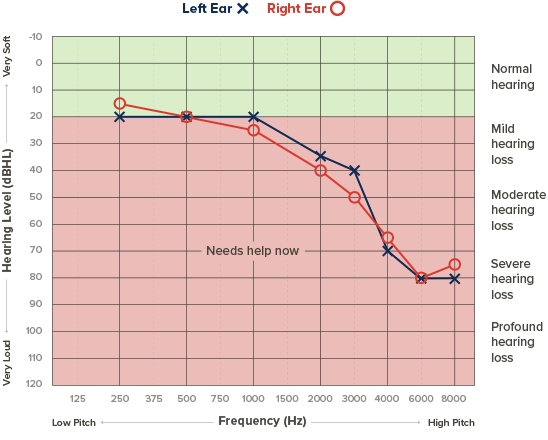
An audiogram is a chart that shows how well you hear different sounds. It’s made during your hearing test appointment, and checks two things:

1. Pitch (Frequencies in Hertz or Hz)
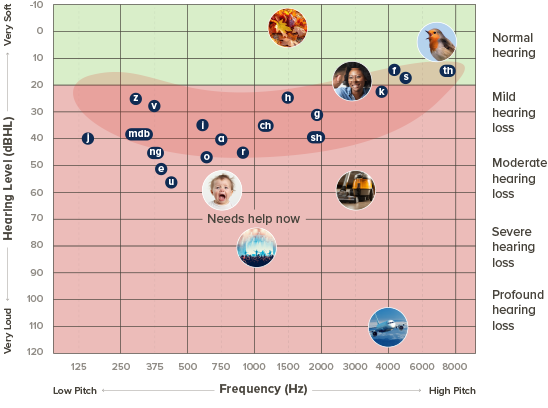
Across the top of the chart, you’ll see low to high-pitched sounds. Everyday talking usually falls around 60–70 decibels.

2. Loudness (Hearing Level in Decibels or dB)
Down the side, the chart shows how loud a sound needs to be for you to hear it—from very soft to very loud.

The “Speech Banana”
In the middle of the chart is a shape called the “Speech Banana.” That’s where most speech sounds fall. It helps show how well you can hear people talking.

Learn more about audiograms

HearingLife Chief Audiologist, Leslie Soiles

Who conducts the hearing test?

During your hearing test appointment, an audiologist or hearing instrument specialist will perform a series of tests and record your results on an audiogram.

Hearing care professionals at Hearing Life identify and treat hearing loss, as well as provide guidance on how to care for your hearing health. If hearing aids are recommended to you, your hearing care professional will discuss which devices would best suit your hearing needs, lifestyle, preferences, and budget and personalize them to you.

Book a FREE hearing test   Why HearingLife?

Understanding your hearing test results

After your hearing test, your hearing care professional will review your results with you. They’ll explain if your hearing is in the normal range or if you have hearing loss.

Your hearing care professional will explain what sounds may be difficult for you to hear, the type and degree of hearing loss (if present), and how it may be affecting your daily life. They’ll also discuss if and what hearing aids could help you to hear better.

Looking at your audiogram is an important step toward better hearing and communication. With expert help, you’ll understand your hearing health and what to do next.

According to the World Health Organization, a normal hearing range means being able to hear sounds between 0 and 20 decibels (dB).1 If you have difficulty hearing sounds within that range, you may have some hearing loss.

Remember: Everyone's hearing is different. Even people the same age or background can have different results. Your hearing is as unique as your fingerprint!

Types of hearing loss

What happens after you receive your hearing test results?

After your comprehensive hearing assessment—which includes several types of hearing tests—your audiologist or hearing instrument specialist will review your audiogram results with you and explain what they mean in clear, easy-to-understand terms. They'll explain if there is any hearing loss present and its severity.

If hearing loss is detected, you'll discuss treatment options, which may include hearing aids. At HearingLife, we provide personalized hearing solutions to help you get the right support for your one-of-a-kind communication needs and lifestyle. Tailoring hearing aids also helps you reap the most benefits from today's advanced hearing technology.

If your audiogram shows no signs of hearing loss, your hearing care professional will let you know if future hearing checks will be needed.

Read about what happens during a hearing test

Sources

1. World Health Organization. (2023, March 1). Deafness and hearing loss.

image of Eva Mathiesen, Clinical Audiologist & Business Analyst
Dr. Husmita Ratanjee-Vanmali, Head of Audiology- Audika Global

Husmita has completed her PhD in Audiology degree specializing in hybrid hearing care models. She has worked in various roles within the audiology sector, from clinical audiologist, researcher, hearing aids and connectivity product trainer to working within the public and private hearing healthcare sectors. She is dedicated to helping more people hear better by applying person-centered care principles.